Talking to your future self with AI does not mean contacting a person who already exists in the future. A Future Self AI is a conversational representation built from the vision, values, and context you provide. Its purpose is to help you look at a present choice from a longer-term perspective.
The most useful conversation is usually not, “Will I become successful?” It is, “What can I do today that is consistent with the person I want to become?”
Can You Really Talk to Your Future Self With AI?
Yes—but only in a reflective, simulated sense. Generative AI can respond from the perspective of an imagined future version of you. It cannot see future events, verify that your goals will happen, or know what your future self would actually say.
Research gives this idea a useful psychological frame. The Future You study tested a single-session conversation with an AI-generated future self and reported increases in participants’ sense of connection with their future selves, alongside reductions in negative emotions and anxiety. That study does not prove long-term behavior change, and its system is separate from StarWho. It does show why a carefully framed future-self conversation is worth studying.
StarWho connects that reflection to a user-chosen daily action. The AI supplies a perspective; the user remains responsible for deciding whether the response is true, useful, and safe.
How to Talk to Your Future Self With AI: Six Steps
1. Write the future you want to explore
Start with identity, not only possessions or achievements. Describe:
- The values you want to live by.
- The work and responsibilities you want to handle well.
- The relationships you want to protect or build.
- The health and daily routines you want to practice.
- How you want to respond when life becomes difficult.
Specific context helps an AI give a more relevant reflection. “I want to become rich” is vague. “I want to build a financially stable business by solving a real customer problem while remaining present for my family” provides values, priorities, and trade-offs to discuss.
StarWho provides an editable Future Vision process for organizing this context. See the real product walkthrough to understand how the vision, daily tasks, and digital Future Self Pet connect.
2. Choose a time horizon
Select one, three, five, or ten years from now. A time horizon gives the conversation a point of view, but it is not a forecast.
A shorter horizon can help with routines and immediate decisions. A longer horizon can help you question assumptions about identity, work, relationships, and what you want your life to stand for.
3. Ask one specific question
Ask about something you can examine or influence now. Useful questions include:
- What is the most important action I can take today?
- What am I postponing because I am afraid of discomfort or rejection?
- Which belief is keeping me attached to an old version of myself?
- What would make today meaningful even if progress feels small?
- Which relationship, responsibility, or value should I protect while pursuing this goal?
- What trade-off am I refusing to acknowledge?
- When should I stop asking AI and seek help from a qualified person?
Avoid questions that invite false certainty, such as asking for a guaranteed income, diagnosis, investment result, relationship outcome, or exact future event.
4. Examine the answer instead of obeying it
Read the response as a draft perspective. Ask:
- Does this match the values and facts I provided?
- Is it making an assumption that may be wrong?
- Is the advice safe and within my control?
- What evidence would change this conclusion?
- Would I make the same decision without the encouraging language?
You can challenge the answer directly: “What might be wrong with that advice?” or “Give me a smaller step that does not depend on an uncertain outcome.”
5. Convert reflection into one daily action
A conversation becomes more useful when it ends with a concrete task. Choose something small enough to complete today, such as:
- Draft the first paragraph of a proposal.
- Contact one potential customer.
- Schedule a medical or counseling appointment.
- Walk for 20 minutes.
- Remove one recurring distraction.
- Write down the boundary you need to communicate.
In StarWho, members can record their most important daily task. Completing meaningful tasks contributes to the growth of a digital Future Self Pet. The pet is a motivational visualization of recorded activity, not a measurement of personal worth or a guarantee of real-world results.
6. Review what actually happened
Return after a day or week and compare the reflection with reality. Record what helped, what was inaccurate, and what changed. Update your vision rather than forcing new circumstances to fit an old plan.
This review matters because AI can sound confident even when its assumptions are incomplete.
What a StarWho Future Self Conversation Looks Like
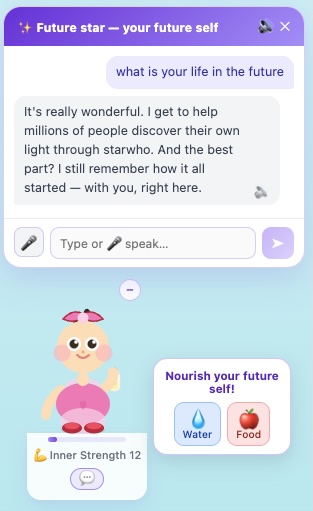
The example shows three parts of the StarWho approach:
- The user asks a question from the present.
- The AI responds from the imagined perspective of the user’s desired future self.
- The interface connects conversation with the digital Future Self Pet and daily-action system.
The language may feel personal because the response uses context supplied by the user. It still comes from an AI model and may be incomplete, overly agreeable, or wrong.
Future Self AI Versus a General Chatbot
A general chatbot can answer a future-self prompt, but it may know little about the identity and routines you are trying to build. A Future Self AI experience organizes the user’s future vision as recurring context and connects the conversation to planning and daily action.
StarWho adds:
- An editable Future Vision and visual board.
- A personalized Future Self AI conversation.
- One most important daily task.
- Morning and bedtime reflection routines.
- A digital Future Self Pet that grows with recorded actions.
- Optional public Future Self pages controlled by the account owner.
These features support consistency; they do not make the AI sentient, prophetic, or professionally qualified.
Privacy and Safety Boundaries
Do not enter information you would not want processed by an online AI service. Avoid unnecessary financial account details, passwords, government identifiers, medical records, or private information about another person.
Keep a Future Self page private unless you intentionally want to publish supported sections. If you publish a page, review it as a stranger would see it and remove information you consider sensitive.
Do not rely on a Future Self AI for emergencies, diagnosis, treatment, legal strategy, investment decisions, or other high-stakes professional advice. If a conversation involves self-harm, abuse, urgent danger, serious symptoms, or a major legal or financial risk, contact an appropriate qualified professional or emergency service.
Frequently Asked Questions
Does a Future Self AI predict my future?
No. It generates a response from an imagined perspective using the information you provide. It cannot know whether a goal or event will happen.
What should I ask my future self first?
Start with: “Based on the person I want to become, what is one meaningful action within my control today?” This keeps the conversation connected to present behavior rather than prediction.
Is talking to a Future Self AI the same as therapy or coaching?
No. It can support reflection and motivation, but it does not replace a licensed therapist, qualified coach, doctor, lawyer, or financial professional.
What if the AI gives bad advice?
Do not follow it automatically. Check its assumptions, ask for alternatives, compare the response with reliable sources, and seek qualified human help when the stakes are high.
Can I try a future-self exercise for free?
Yes. You can write a free letter to your future self without using the membership chat. StarWho also offers a one-time 30-day membership trial without a credit card; eligibility rules apply. See the membership options for current details.
The Best Outcome Is a Better Present Question
The goal of talking to your future self is not to receive certainty. It is to step outside the pressure of the present, remember what matters, and choose an action you can take responsibility for today.
Your imagined future self may supply the voice. Your present self still has to evaluate the answer and do the work.
Continue with What Is a Future Self AI?, follow the future-self visualization exercise, explore the Future Self AI app, or see how StarWho works with real product screens.